 |
 |
 |
 |
 |
 |
 |
 |
|
 |
|
 |
48 The Earths magnetic field
|
| Menu | back |
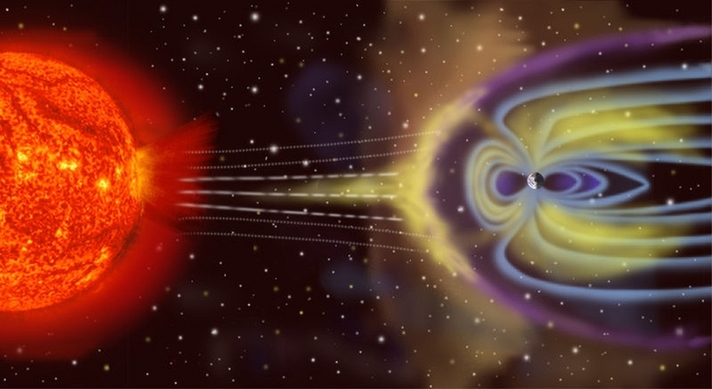
Most planets have their own magnetic field, also the sun. One would expect these magnetic fields to have a longer or shorter life depending on the hypotheses of the origin. Measurements of the Earths magnetic field have indicated a continuous decrease over the last approximately 170 years. Based on these measurements, it is possible to estimate the age of the Earths magnetic field to be fewer than 10,000 years old.
|
 |
| Magnetosphere | |
The Earth has a solid inner core of iron surrounded by a liquid core which is surrounded by a solid stone crust. The globe rotates causing the liquid portion of the core to move in a helical form due to Coriolis force. One can imagine that this motion has generated a dynamo that could have been responsible for development of the initially weak magnetic field of the Earth (dynamo theory). However, it has not yet been possible to reproduce this with any satisfactory mathematical model. On the contrary, the measured data indicates that the Earth was created with a relatively strong magnetic field, which continuously decreases (1).
The Earths magnetic field has been measured since 1835. The measurements show that the field strength decreased by eight percent between 1835 and 1965. The various measurements allowed the conclusion that the magnetic fields strength may be reduced by half every 1,465 years. Measurements performed by the geophysical observatory in Munich show that the Earths magnetic field has decreased for approximately 3,000 years. If it continues at this rate, it will no longer exist in 4,000 years (2).
Reversal of the poles of the Earths magnetic field:
During development of geological strata, all magnetisable particles are aligned according to the current effective magnetic field and fixed in this direction. It has been found that the Earths magnetic field has reversed its polarity many times in the past.
According to common doctrine, the polarity reversed every 250,000 years on average. This number is obtained by comparing the polarity reversal events documented in the geological strata with radiometric age. However, an angular change of approximately six degrees per day was observed in lava flows on Steens Mountain, Oregon, USA (3). This means the local magnetic field could have reversed its polarity within approximately thirty days at the time of lava flow (4).
The present decrease of the Earths magnetic field could initiate a reversal of the polarity. But this is unlikely. Such an event would happen fast. It is possible that the magnetic field reversed several times during the great flood and that its intensity is decreasing since creation.
The common dynamo theory:
It is not possible to answer many important questions with the common dynamo theory (5). This applies particularly to the question of how the gigantic quantities of liquid iron inside the Earth could have changed the direction of the magnetic flux. Was the Earths magnetic field actually created by the rotation of the iron core? The only fact that can be assumed with high probability is that the position of the poles has changed only insignificantly during the Earths history (6).
These 49 | Menu |
back
|
References:
|
| (1) |
D. Russel Humphreys, The Earth´s Magnetic Field is still losing energy, CRSQ 39/1 March, 2002, pages 313. |
| (2) |
Geophysikalisches Observatorium in München, 3sat nano, 29. August 2002. |
| (3) |
R.S. Coe, M. Prévot und P. Camps, New Evidence for extraordinarily rapid change of the geomagnetic field during a reversal, Nature 374, 20 April, 2002, pages 687692. |
| (4) |
R.S. Coe und M. Prévot, Evidence suggesting extremely rapid field variation during a geomagnetic reversal, Earth and Planetary, Science Letters 92/3-4, April 1989, pages 292298. |
| (5) |
M.R.E. Proctor und A.D. Gilbert, Lectures on Solar and Planetary Dynamos, Cambridge University Press, 1994. |
| (6) |
Proceedings of the NATO Advanced Study Institute, "Theory of Solar and Planetary Dynamos", Isaac Newton Institute, Cambridge University, 20 Sept. to 2 Oct., 1992. | |
| |
| (Image) http://en.wikipedia.org/wiki/Earth%27s_magnetic_field |
| |
Comment this Site!
|
 |
|
 |
|
|
)