 |
 |
 |
 |
 |
 |
 |
 |
|
 |
|
 |
58 Earth to moon distance
|
| Menu | back |
The moon orbits the Earth and its gravitational attraction is responsible for the tides in the worlds oceans. Gigantic masses of water are pushed back and forth requiring a great deal of energy. The moon supplies this energy by moving away from the Earth by 3.8 cm each year. Even if the Earth and moon had originally touched one another, this process could therefore have continued for a maximum of 1.3 billion years. This is too short for the alleged 4.6 billion year old Earth/moon system.
Over a century ago, the astronomer George Darwin, son of Charles Darwin, discovered that the moon was moving away from the Earth in a slow spiral. The reason for this is the mutual tide effect of Earth and moon. The moon moves away from the Earth at a rate of 3.8 cm per year.
|
 |
|
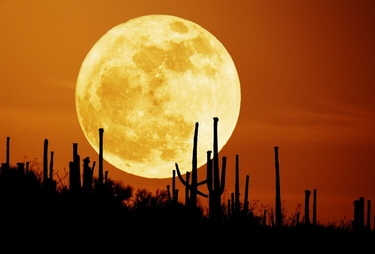
| Full moon |
| Although this value is small, it cannot be ignored over long periods. Interesting in this respect is that the tide effect shows a very pronounced function of the distance between Earth and moon. For this reason, the variations must have been much greater in the past as the moon was closer to the Earth, than it is today (1).
Calculating the time for the moon to get to the present distance, we get 1.3 billion years (2). It would have been in contact with the Earth 1.3 billion years ago. Moreover, one billion years ago, it still would have been so close to the Earth that it would have caused extremely high tides. The geologic formations should have to show if there had been such high tides, but they show nothing.
Stabilization of Earths axis:
The moon causes the tides on the worlds oceans; however, it also contributes to the stabilization of the Earths axis. Jacques Laskar found that the Earths axis could fluctuate by up to eighty degrees if the moon with its relatively high mass would not stabilize it. The angular position of the Earths axis appears to be quite stable at 23.3 degrees.
These 59 | Menu |
back
|
Reference:
|
| (1) |
Dann(1)y R. Faulkner, The current state of creation Astronomy, Proceedings of the Fourth International Conference on Creationism, 1998, page 208. | |
(2) Don B. DeYoung. The Earth-Moon System. Proceedings of the second International Conference on Creationism, Pittsburgh, USA (1990): page 81.
|
| (Image) http://amandabauer.blogspot.com/2007/09/under-full-moon.html |
| |
Comment this Site!
Chris Kay wrote:
get your maths right!!
3.8cm/year x 1 bilion years (10^9) = 3.8*10 ^(-5)km x 10^(+9) = 3.8* 10^(+4) km = 38,000 km
this is 10% of the Earth-Moon distance (the orbit of geostationary satellites!!!)
|
 |
|
 |
|
|
)